


Electrical Metering Requirements for Multi-Tenant Buildings

In multi-tenant residential or mixed-use buildings, the question of whether each tenant needs a separate electric meter (or submeter) is both a code and utility issue. As engineers, architects, and property owners in New York City, we must navigate building codes, New York State and PSC metering rules, and local laws like NYC’s Article 311. In this post, we break down when separate meters or submeters are required, how to comply, and how to avoid common mistakes in design and permitting.
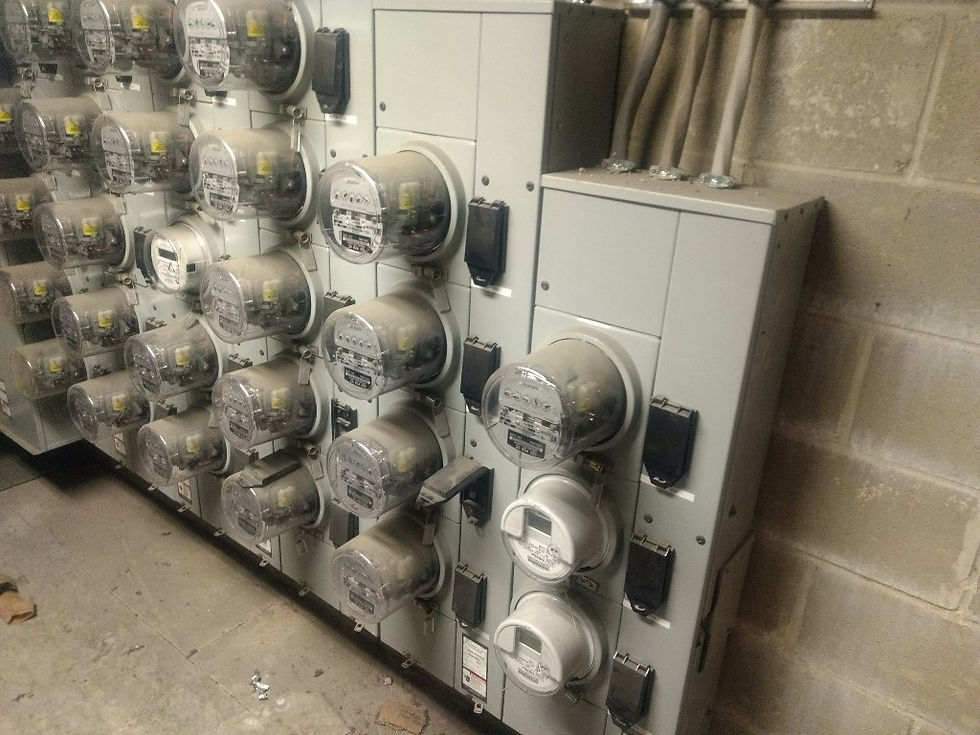
When Must Separate Meters or Submeters Be Provided?
Below are common scenarios and when separate metering is required by code or utility rules:
1) Commercial Tenant Spaces in Covered Buildings (Article 311)
If the space is a covered tenant space, you must sub-meter it by Jan 1, 2025, unless it already has a dedicated utility meter. Provide monthly statements.
2) Large Non-Residential Tenants (LL88)
In buildings >25,000 ft², each tenant ≥5,000 ft² must have a sub-meter and receive monthly statements; 2025 compliance.
3) Residential Buildings - Avoid “Shared Meter” Conditions
A tenant’s meter cannot feed common areas or other units; if a shared meter is discovered, the owner must eliminate it unless “minimal use” or other limited exceptions apply (< 75 kWh/mo or < 5 ccf/mo or < 10%).
4) Small Residential (1–4 DUs) - Limit on Meter Count
Utilities won’t energize more meters than the number of lawful dwelling units without DOB sign-off. Plan metering accordingly.
5) Residential Submetering Design (Statewide)
If you submeter residential units, use PSC-approved systems and ensure individual shutoff capability (for new/replacement systems after 1/1/2016).
Key definitions (Article 311): A “covered tenant space” is a non-residential tenant space meeting Article 311’s size criteria within a covered building. Dwelling units are excluded.
Key NYC & State Metering Requirements
Here’s a breakdown of the main legal drivers in NYC and New York State for electric metering in multi-tenant buildings:
Topic | Primary Authority | What It Says |
Submetering of tenant spaces (NYC) | NYC Admin. Code §28-311 (Article 311) | In covered buildings, each covered tenant space must be measured by one or more sub-meters on/after Jan 1, 2025, and tenants must receive monthly statements. Dwelling units R-2/R-3 are excluded. |
LL88 threshold & timing | LL88 & subsequent updates | For buildings >25,000 ft², submeter large non-residential tenant spaces ≥5,000 ft² and provide monthly statements; deadline 2025. |
Shared Meter (state law) | PSL §52; PSC guidance | Residential “shared meters” are generally prohibited; “minimal use” defined as < 75 kWh/mo electric or < 5 ccf/mo gas (or < 10% of total) allows limited agreements; otherwise the owner must remedy. |
Residential submetering rules | 16 NYCRR Part 96 | Requires PSC-approved equipment, HEFPA compliance, and for new/replacement systems post-1/1/2016, ability to terminate service to individual units. |
1–4 family meter limits (NYC) | NYC Admin. Code §27-3021.1 | Utility may not energize more meters than dwelling units (without DOB sign-off). |
Electrical Metering for Multi-Tenant Buildings
BUILT Engineers Can Help
At BUILT Engineers we provide integrated MEP/FP engineering services tailored to NYC’s strict code and utility environment. We assist clients with:
Metering scheme design, distribution layouts, and panel coordination
Code compliance and interpretation
Permit documentation and reviews with DOB and utility
Coordination with landlords, tenant buildouts, and electric service providers
Metering verification and inspection support
If you’re planning a multi-tenant project or reviewing an existing building for compliance, contact BUILT Engineers today. Our team will help you design, document, and permit a metering system that meets NYC code the first time.


Comments